
Origin of Bingo: The Surprising History Behind the Beloved Game
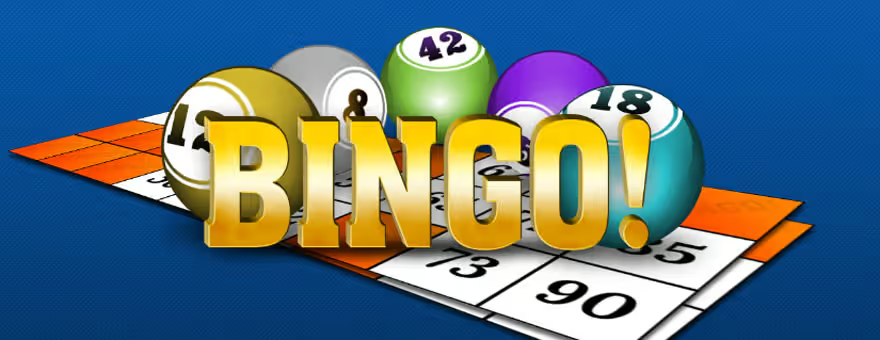
If there’s one game that refuses to fade away no matter how digital the world gets, it’s Bingo. Somehow, it has mastered the art of being both the quintessential grandma pastime and a Friday night thrill for the Zoomer crowd. It’s a party favorite, a retirement home staple, and let’s face it—nothing beats the rush of yelling “Bingo!” before anyone else. But have you ever wondered where this shouty, dot-filled game even came from? Spoiler: it didn’t just pop out of nowhere like your aunt’s lucky dabber.
From Italian roots to French flair
Turns out, Bingo’s roots go way back. Like, Renaissance-era back. It all started in Italy in the 1500s with a lottery-style game called “Il Gioco del Lotto d’Italia.” This wasn’t some casual Sunday hobby; it was serious business, played with numbered cards and all the pomp you’d expect from a game enjoyed by the Italian elite. Eventually, like all cool things, it made its way to France. The French nobility gave it a little zhuzh, turned it into “Le Lotto,” and now we’re talking fancy wooden tokens and velvet bags—basically the designer handbag of board games.
The German twist
Now, the Germans saw this stylish number game and thought, “What if we make it educational?” Naturally. They rebranded it for teaching kids math, spelling, and history. Which, by the way, is the ultimate plot twist for a game now synonymous with people chasing cash prizes and bragging rights. Imagine being told your math lessons today would be learning through Bingo. The 18th-century German kids probably didn’t realize how good they had it.
America’s accidental Bingo boom
So how did this European delight end up dominating American church halls and casinos? Enter a carnival in Jacksonville, Georgia, in the 1920s. Here, the game was known as “Beano.” Players would mark their cards with beans and shout “Beano!” when they scored a win. Then, as legend has it, someone got a little too excited and accidentally yelled “Bingo!” instead. A toy salesman named Edwin Lowe overheard this and thought, “That’s catchy!” He took it, ran with it, and packaged it into the Bingo we all know today. Thank you, random enthusiastic carnival-goer—you created a cultural icon.
It wasn’t just a fun accident either. Lowe worked with a mathematician to create thousands of unique Bingo card combinations to prevent repeats. This is the nerdy backend we don’t see when we’re just trying to cross off numbers and score a line.
Bingo’s modern-day glow-up
Today, Bingo’s got a whole new vibe. Sure, the community halls still thrive, but you’ve also got snazzy online versions, themed Bingo nights, and apps that let you play while you’re pretending to answer emails. Whether you want a quick game on your lunch break or a virtual party night with friends, Bingo’s there, waiting with its satisfying little dab marks and that glorious B-I-N-G-O spelling.
And guess what? This timeless game isn’t just surviving—it’s thriving because it’s so easy to adapt. Whether you’re playing on a beach towel with numbered seashells or via an app with avatars and sparkles, the heart of the game remains unchanged.