
How the First Casinos Started: A Fascinating Look at Their Early History
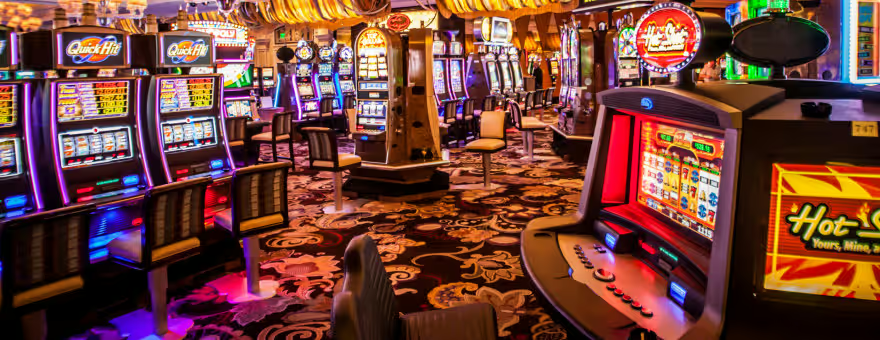
Gambling has been around for almost as long as human society existed. People convened and gambled over a lottery game somewhere in ancient Tiangkok more than 2,000 years ago. Gambling houses have been around even before the word ‘casino’ was used to refer to them. There was a reason that the origin of the word referred to ‘a house’ (casa). Casinos were more than gambling houses; there were performances, house rules, and they used to be places where art flowed more freely.
Let’s look into the colorful history of the establishments of what led to casinos that we know today.
It was agreed on that 1638 was the year when the first establishment served the basis of what evolved into our world’s modern casinos. Il Ridotto was established by the Great Council of Venice as a means to centralize a gambling place during their annual Spring Carnival. A code of anonymity was set in place by wearing three-cornered hats and masks, and only society’s elites were allowed to participate in them.
Jump to the 1760s, and we get the Redoute, now known as the Casino de Spa. It sounds like a resort to the unaware, because it was. The town it was built on was known for its mineral-rich thermal waters. This combines gambling with entertainment and surprisingly enough, health benefits thanks to the pouhons that were common in the place. It was well-liked by kings and queens; even Tsar Peter the Great wanted to create his own thermal paradise in Russia. Casino de Spa also holds the honor of being the longest-running casino anywhere. If the longest F1 circuit in the world doesn’t mean much, maybe this will.
Let’s move to 19th Century United States of America, where floating casinos were the in-thing for everyone trying out their luck. With river travel was on the decline of being first-choice transportation, those paddlewheel boats had to serve another use. Riverboats were considered nano-states at the time. The law didn’t extend to the floating funhouses, and their owners were more than happy to take what extra income gamblers brought to their business. With the captain’s word being law, and riverboats were beyond the reach of jurisdictions and ordinances, little could be done to prevent the rise of “Riverboat gamblers”, who played games like Poker, Faro, and Vingt-et-Un. There were also “card sharps” and “confidence men”, often playing with rigged decks and sleight of hand to fleece unwary travelers.
Later in the same century, Charles III, a prince on the verge of bankruptcy, ‘tried his luck’ and built a casino in the principality of Monaco. By 1869, the casino was successful that taxation was abolished in the principality. Further expansion such as larger gaming rooms, and even an opera house continued through the rest of the 19th Century. In fact, the settlement built around the establishment was named Monte-Carlo, in honor of the prince. The Casino de Monte-Carlo inspired some James Bond stories, which helped in their ways to cement the casino’s legacy.
There was more to casinos than plain gambling, though the neon lights and ambient sounds drive people to try their luck with winning a bit of money. Traces of the artistic and cultural sides of casinos could be seen even today.